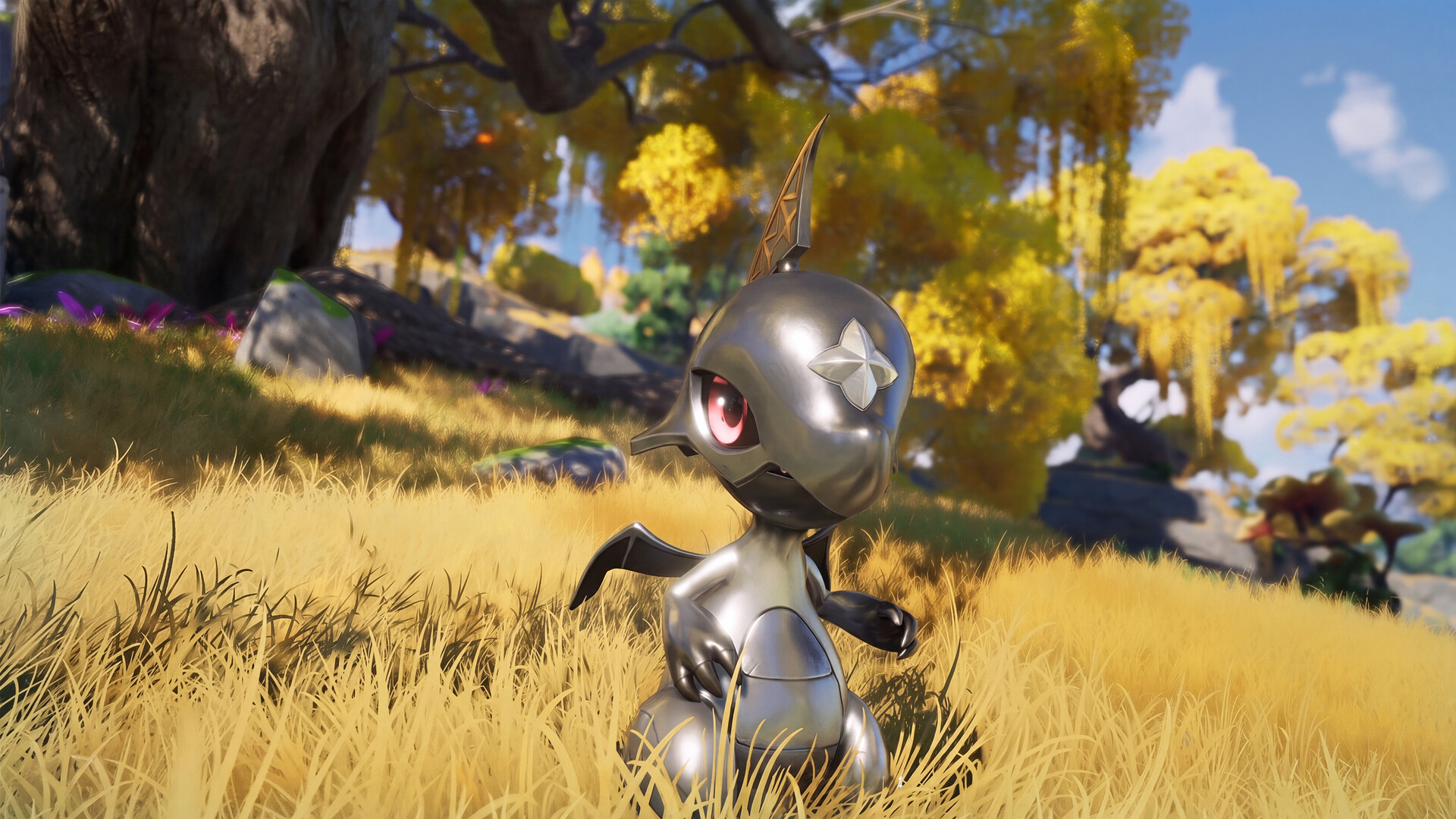
What Twining Is
Twining is merging with one of your Aniimo and taking its form. The game's own description puts it plainly: you can twine with an Aniimo and essentially become any Aniimo that you collect, using that creature's skills to solve puzzles, win battles and overcome challenges.
This one mechanic reorganises the whole game. In a conventional creature-collector, your team is a set of options you call on — you stay yourself, and the creatures act for you. In Aniimo, collecting a creature is partly about unlocking a way of moving and fighting for yourself. That is why the roster matters so much more here than a simple damage comparison suggests: a creature you would never put in a damage slot can still be the single most useful thing you own if its form solves an obstacle or crosses terrain nothing else can.
The developers frame it as the identity of the game — the official tagline is "Twine to find a new perspective," and the official site describes merging with your Aniimo to gain new abilities and strengthen your connection. Community discussion regularly treats it as the reason to play Aniimo over similar open-world creature games, both for and against: it is the feature that makes the game feel unlike the alternatives.
Command mode: your Aniimo fights, you direct it. Twine mode: you are the Aniimo, and you use its skills directly. Both are available, and knowing when to switch is the actual skill.
How to Twine
Twining is not something you unlock late — it is part of the core loop from early on, and the game introduces it as a primary system rather than an advanced technique. What follows is the practical shape of it, described at the level we can confirm from official material and in-game flow.
- Have the Aniimo in your collection. You can only twine with an Aniimo you have caught. This is why catching broadly matters more than catching selectively at the start — every catch is a new form available to you.
- Switch into the Aniimo's form. Twining is triggered from your active party rather than from a menu you have to dig through. The game treats it as a fast, in-play action, not a prep-screen decision.
- You are now playing as the Aniimo. Your skills, your movement options and your combat behaviour are all now the creature's. Emberpup's Hustle, for example, becomes your movement ability while twined.
- Switch back when you need to. Returning to your own form is available at any point, and mid-combat swapping is part of how fights are meant to be played.
We are deliberately not printing specific button prompts or keybinds here. Control schemes differ by platform, and a wrong keybind costs you a fight. The in-game tutorial covers the exact input for your platform, and the system is introduced through normal play. What matters is the decision-making around Twining, which is what the rest of this page covers.
What Changes When You Twine
Four things change, and each one matters for a different reason.
Your skills become the Aniimo's skills
You gain access to that creature's combat and innate skills, with their own elements, costs and power values. This is the most obvious change and the reason Twining is a combat tool. A creature with a high-power skill is worth twining with precisely for that skill.
Your element becomes the Aniimo's element
Twining changes your effective element, which means it changes every matchup calculation on this site's element chart. Twining into a Fire Aniimo against an Ice enemy is a different fight than twining into a Water one. This is subtle and it is where most of the depth lives: your choice of twine target is an elemental decision, not just a stat decision.
Your movement changes
Each Aniimo carries its own mobility ability, and it becomes yours while twined. Emberpup's Hustle increases movement speed while consuming stamina. Others glide, dive or burrow. Because Aniimo has no separate mount system, this is how you traverse at speed — your Aniimo is your movement.
Your traits apply
Aniimo carry a trait that modifies how they fight, such as Emberpup's Scorching Flames, which increases damage dealt to enemies weak to your element by 15%. When you twine, that trait is part of your kit.
| What changes | Why it matters |
|---|---|
| Skills | You use the Aniimo's skill set, including its innate skills. |
| Element | Matchups are recalculated — this decides damage dealt and taken. |
| Mobility | Traversal ability becomes yours; Aniimo has no separate mounts. |
| Trait | The Aniimo's passive trait is active while you are twined. |
Twine Mode vs Command Mode
Aniimo has two ways to fight, and the interesting part is that you choose between them per situation rather than picking one for the whole game.
Command mode is the conventional setup: your Aniimo fights while you direct it. This keeps you at a distance, lets you coordinate a team rather than one creature, and is generally the safer posture when you want to manage several threats at once.
Twine mode puts you in direct control of the creature. You get its skills at your own timing, and you take its damage profile. This is higher-risk and higher-agency — it is how you land a specific skill exactly when you want it rather than waiting on an AI to choose.
You can swap between them mid-fight, and that flexibility is the point. Opening in Command to read the fight and shifting to Twine to close it out is a pattern worth practising early.
Where your player form is still required
You cannot be twined everywhere. In hub areas and when working on your Homeland — the personal base where you plant crops, build decorations and arrange a space for your Aniimo — you are in your own form, as a Pathfinder. Twining is for the field and for combat, not for managing your base.
Twining and Getting Around
Because Aniimo has no separate mount system, traversal is entirely a Twining question. The official material describes gliding, diving and burrowing as ways you can step foot anywhere — and those are Aniimo abilities, not player abilities.
The practical consequence: your exploration speed is a function of your roster, not your character. A player with one fast Aniimo crosses the map quicker than a player with five slow ones. When you are deciding what to catch next, an Aniimo with a strong mobility ability is worth catching even if you never intend to use it in combat.
Keep at least one dedicated traversal Aniimo in your active party at all times. Swapping to it costs a moment; walking across a region costs minutes. The trade is always worth it.
Choosing What to Twine With
There is no single best Aniimo to twine with, because the right answer depends entirely on what you are doing. Judge a twine target on four questions instead of a tier list:
- What am I facing? Element first. Pick a form whose element is strong into your current enemies — check the weakness chart.
- What am I doing? A puzzle that needs a specific innate skill, or terrain that needs a specific mobility ability, determines the pick far more than damage does.
- What skill do I need right now? If you need a break tool against an armoured target, twine into something built for it rather than your highest-damage option.
- How long will I stay twined? For a long exploration run, trait and mobility matter more. For a short boss burst, raw skill power matters more.
For the early game specifically, the Best Starters page covers which Aniimo give you the most useful forms to start with, and the full Aniimo list lets you filter by element and role to find a specific ability you are looking for.
Common Mistakes
Staying twined permanently
Some players find a form they like and never leave it. That throws away half the system. Command mode is genuinely better in multi-target fights and in any situation where you want to watch the whole field rather than commit to one creature's perspective.
Ignoring the element side of Twining
Twining into your strongest Aniimo regardless of element is the most common combat mistake. A high-power Fire Aniimo twined into a Water fight will underperform a mediocre Electric one. The element change is not a side effect — it is one of the four main things Twining does.
Not catching Aniimo you do not plan to fight with
Every catch is a form. An Aniimo that is useless in a damage slot can still be the key to a puzzle or a shortcut. Catching broadly early pays off in traversal options later.
Treating mobility as a minor stat
With no mounts, mobility abilities are your only speed lever. Deprioritising them makes every part of the game slower.
Assuming Twining works in hubs
Your Homeland and hub areas keep you in player form. Planning to solve something by twining inside a base will not work.
FAQ
What is Twining in Aniimo?
Twining is merging with an Aniimo you have collected and taking its form, using its skills and abilities directly rather than commanding it.
Can I twine with any Aniimo?
You can twine with any Aniimo you have caught. Catching is the gate, which is why a broad collection has value beyond combat.
Does Twining replace mounts?
Effectively yes. Aniimo has no separate mount system, so traversal is handled through the mobility abilities of the Aniimo you twine with.
Can I switch out of Twining mid-fight?
Yes. Switching between Twine mode and Command mode during combat is part of how fights are designed to be played.
Do I keep my own abilities while twined?
No — you take on the Aniimo's skills, element, mobility and trait. That substitution is the mechanic.
Can I twine while at my Homeland?
No. Hub areas and Homeland management keep you in your own Pathfinder form.
Is Twining required for puzzles?
Some puzzles and obstacles are solved using Aniimo innate skills, so a broader roster gives you more ways through the world.