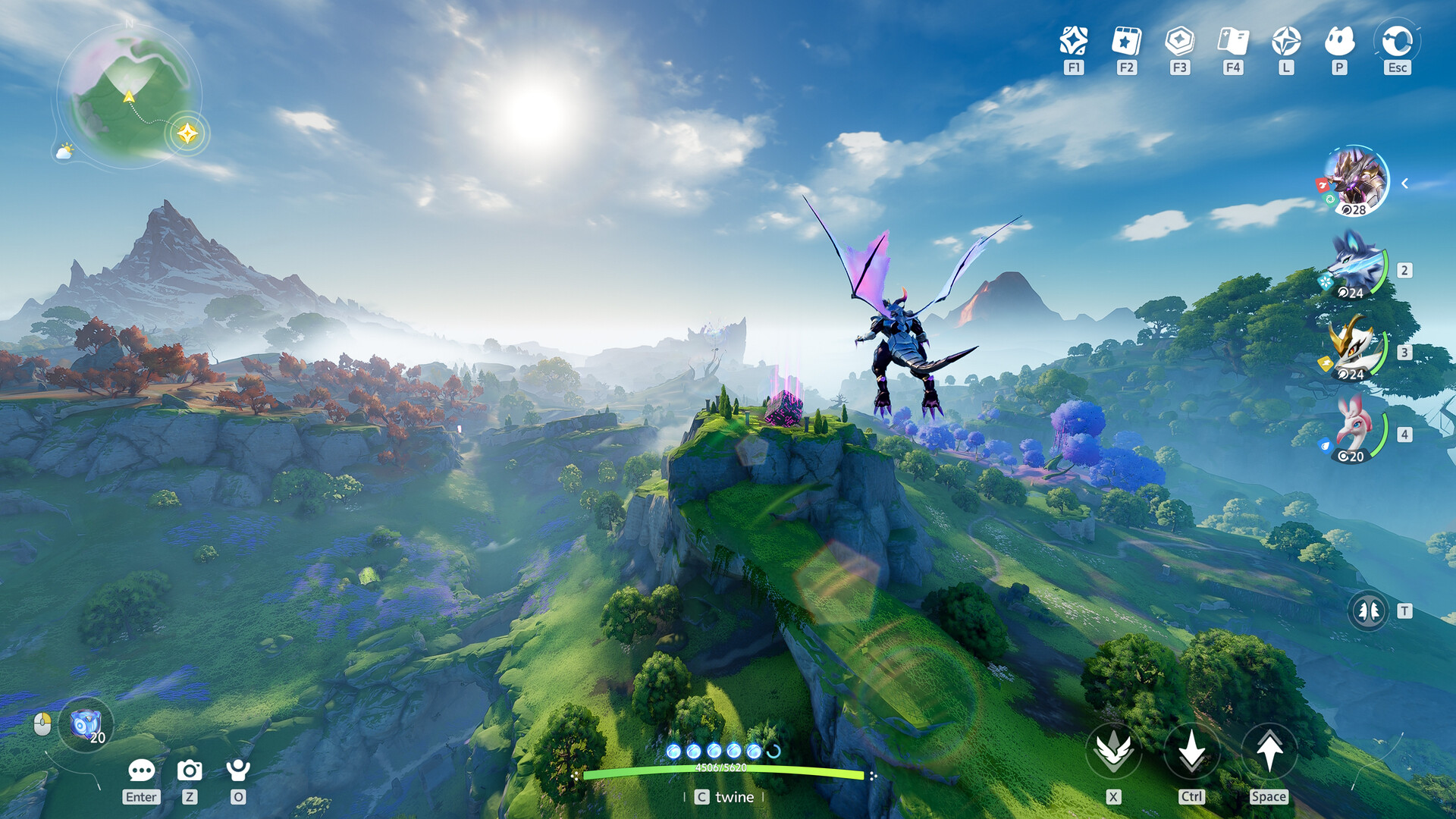
Map Overview — Idyll
Aniimo takes place on the continent of Idyll. You explore it as a Pathfinder, and the world is split into named regions rather than a single open plain — each with its own climate, terrain and creature population. A sky-floating metropolis serves as the social hub where Pathfinders gather and competitions are held.
Two things shape how you should read this map:
- Spawns are environment-driven, not fixed. The official material states that unique Aniimo appear according to the environment, weather, phenomena and time of day. A region is not a single spawn table — it is several, and which one is active depends on conditions.
- Terrain is gated by Twining, not by gear. Because Aniimo has no mount system, reaching a region's harder areas depends on which traversal abilities you have. A region you cannot fully explore today may open up completely after one catch — see the Twining Guide for how mobility works.
We are not publishing exact X/Y coordinates for each spawn. Coordinates shift with the conditions described above, and a static pin would be wrong more often than right — which sends you to a spot and wastes your session. Region-level guidance is what actually holds up; precise per-creature spot data belongs in an interactive map, which is a planned upgrade rather than something we will fake with static numbers.
Regions & What Spawns There
Idyll is divided into named regions, and the official index assigns habitats per creature. Five region names are confirmed in English from the official Aniimo index, and these are the ones we can publish with confidence:
| Region | Terrain & character | Confirmed Aniimo |
|---|---|---|
| Nimbus Fields | Open grassland — the broadest early region, bright sky and meadow terrain | Emberpup |
| Mistwoods | Forest with heavy ground cover; concealing terrain | Emberpup |
| The Argent Strait | Coastal water and cliffs | Emberpup |
| Echoback Landing | Shoreline and shallows | Emberpup |
| Beast Fang Ridge | Rugged highland ridge; the tougher early region | Emberpup |
The official index publishes habitat data per creature, and Emberpup — the first dex entry — lists all five of the regions above. Other creatures' habitat data is not currently readable from an official English source, so we are not filling the remaining rows with region names we cannot verify. A translated guess at a region name is worse than no entry: it sends you to the wrong place and costs you a session.
What we can tell you with confidence is the shape of the world:
- At least 14 distinct regions exist, covering grassland, forest, coastal water, highland, rocky terrace and snow terrain.
- Regions skew by element. Coastal and shallows regions carry Water; highland and rocky regions carry Rock and Fire; the coldest region carries Ice. Planning a farming trip by element is more reliable than planning by proximity.
- Every region can hold more than one element. Nimbus Fields alone carries several, and Emberpup — a Fire Aniimo — appears in forest and coastal regions too, not only in grassland.
Until more region data is confirmed, use the element sections of the full Aniimo list to decide what you need, then explore the terrain type that matches that element. The habit in the next section — revisiting regions under different conditions — will find you more creatures than any region list will.
Spawns Change With Conditions
This is the single most important idea on this page, and the reason a static map is never finished. Four factors decide what is actually standing in front of you:
- Environment. The region and terrain type — forest, coast, highland, snow. This is the baseline and the thing you can plan around most reliably.
- Weather. Weather changes spawns. A rainstorm is not just atmosphere; it can be the condition a specific Aniimo requires.
- Phenomena. The official material lists phenomena as a distinct spawn factor alongside weather, meaning there are world events or environmental states that alter what appears.
- Time of day. Day and night spawn different creatures in the same spot.
Go back. A region you cleared at midday may have something different in it at night, or in the rain. Players who treat regions as one-and-done miss a large portion of the roster — and the Aniimo that need specific conditions are exactly the ones other players are also struggling to find.
Rare Forms & Where to Find Them
Aniimo has more than one layer of rarity, and they work differently from each other.
Forms
Individual Aniimo have multiple named forms — Emberpup, for example, exists in Basic Form, Highland Form and Mountain Woods Form. Forms are tied to where the creature is found, which means the same Aniimo can present differently depending on the region you catch it in. If you have caught an Aniimo once and written it off, check whether it has another form you have not seen.
Prismana
Prismana is the rare variant layer. The official launch programme gives every player one Prismana Form Aniimo of their choosing, and Prismana forms otherwise appear as rare encounters in the world. This is the rarity tier worth actively hunting, and the one that genuinely changes a creature's desirability — see Best Starters for how to use your free pick well.
Special entries
Two Aniimo sit outside the main dex numbering: NO.9997 Fennelun and NO.9998 Helion. Both are Holy element, the rarest in the game with only two entries total. Their special numbering reflects that they are not part of the standard regional progression.
Efficient Farming Routes
Once Aniimo has no mounts, so route efficiency is about your roster rather than your travel speed. These principles apply to any region:
- Chain by element, not by distance. Going Emberpup and Flameruff (Fire, Nimbus Fields) then wanting Grass and Electric means a long trip. Instead, clear regions whose elements are useful to you in one pass and bank the catches together.
- Start with your fastest twine form. You should enter a long farming run already twined into your best mobility Aniimo, not switch once you arrive. See the Twining Guide for why mobility is the most underrated stat in the game.
- Farm with the element that beats the region. Running a Water region with an Electric attacker turns a slow grind into a fast one — check the element chart before you set out.
- Sweep a region at two times of day. If you are going to travel somewhere, get both the day and night spawns in one trip rather than making two journeys.
- Bank your catches before you evolve anything. Catch first, decide what to invest in later. Catching is cheap; evolving the wrong creature is not.
Keep one Aniimo of each element in your capture rotation rather than specialising hard early. The roster is broad — 19 Water Aniimo, 16 Grass, 16 Rock, 14 Wind — and having coverage in every element means no region is ever wasted travel.
Materials & Resources
Exploration in Aniimo is not only about catching. Two other systems are tied to being out in the world:
Your Homeland
Your personal base — an RV on a campsite — is where you plant crops, build decorations and arrange a space for your Aniimo. It is one of the game's core systems rather than optional flavour, and it gives exploration a return loop: you gather in the world, then build at home.
Launch rewards and currencies
The official launch programme distributes Glimmer and other rewards through milestone tiers and log-in rewards, along with items including the Aniipod Ultra and a Tumbler. These arrive through the mailbox rather than through codes — see the Codes page for why there is nothing to redeem.
We are not listing per-material drop locations. The official index does not publish them, and a guessed material table would send you farming the wrong region. Once drop data is documented, it belongs on this page with a verified source.
FAQ
What is the Aniimo map called?
The game takes place on the continent of Idyll, which is divided into named regions such as Nimbus Fields, Mistwoods and The Argent Strait.
Do Aniimo spawn in fixed locations?
No. Spawns depend on environment, weather, phenomena and time of day, so the same region produces different creatures under different conditions.
How do I find a specific Aniimo?
Find its region first, then revisit that region at different times of day and in different weather. Condition-dependent Aniimo cannot be reliably found by hunting one spot at one time.
Why is there no interactive map yet?
An interactive map is a planned upgrade. We are not publishing static coordinates because spawn conditions make them unreliable, and a wrong pin wastes more of your time than no pin.
Are there rare Aniimo variants?
Yes. Prismana is the rare variant layer, and the launch programme grants every player one Prismana Form pick. Individual Aniimo also have multiple named forms tied to where they are caught.
Do I need to unlock regions?
Exploration is gated by traversal ability rather than by gear. Because there are no mounts, reaching a region's harder areas depends on which Aniimo mobility abilities you have — so a region you cannot fully explore now may open up after one good catch.
How many regions are there?
The official habitat data we can read lists at least 14 distinct regions across grassland, forest, coastal, highland, rocky and snow terrain. Only five are confirmed by their English names so far, and we publish those rather than guessing at translations.